
Are pigeons under solar panels actually a problem?
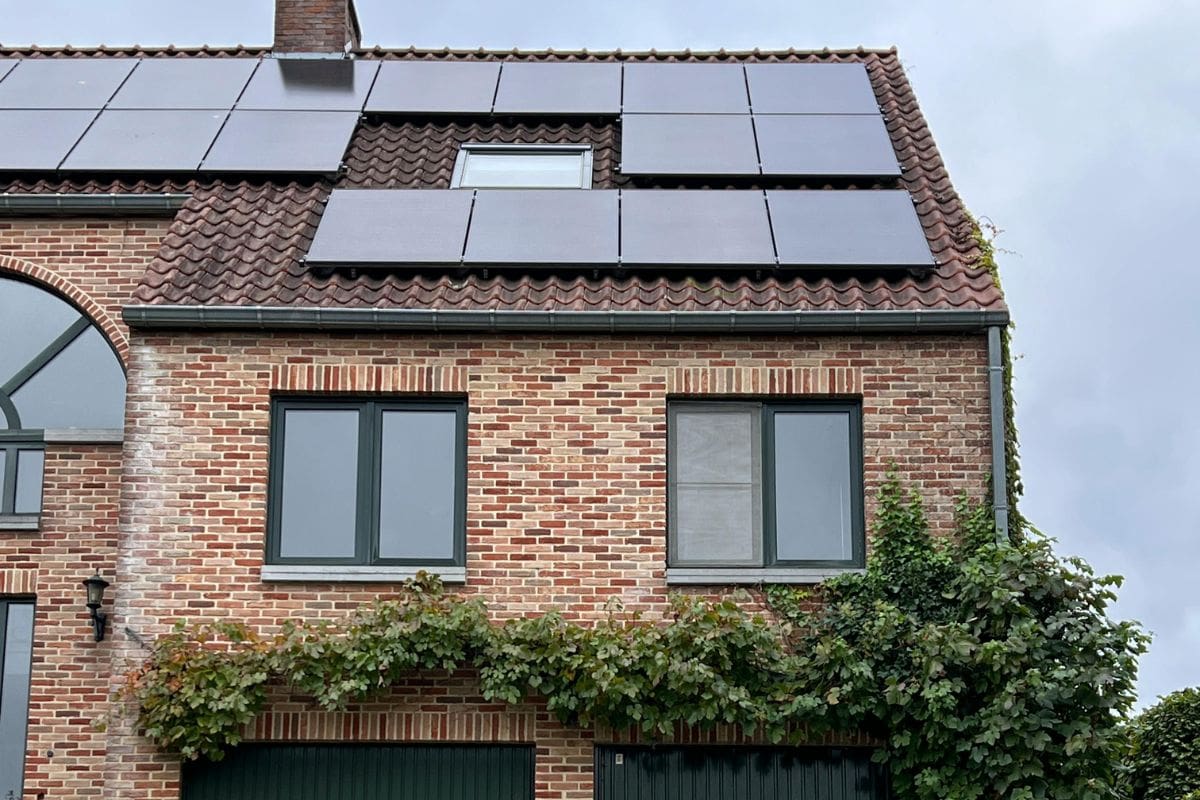
Yes, and a more expensive one than most people realise. That’s why solar panel protection from pigeons is key consideration in protecting your investment.
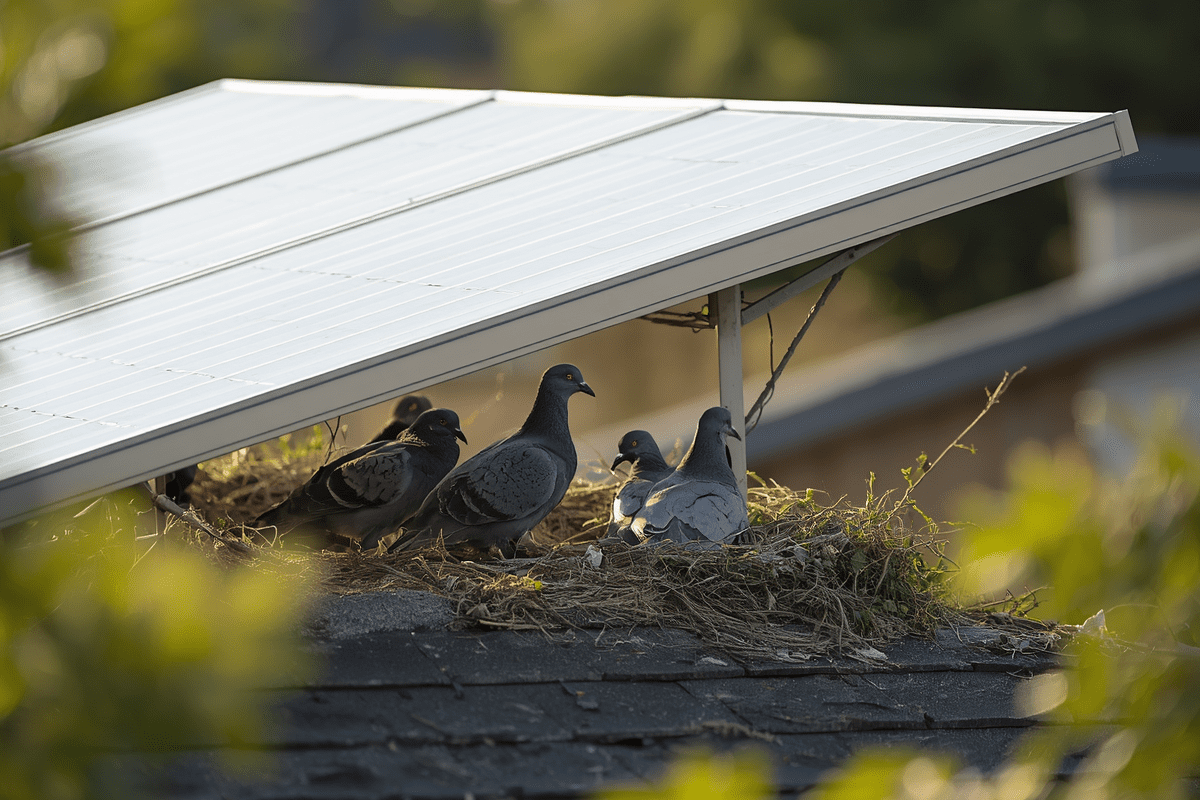
The problem is, the space between your panels and your roof is warm, dry, sheltered from wind and rain, and free from predators. From a pigeon’s point of view, it’s the best home they’re ever going to find. Once a pair moves in and starts breeding, the rest of their flock tends to follow.
The actual damage comes in three forms. First, the droppings. Pigeon guano is acidic. It corrodes metal fixings, stains panels, blocks gutters and creates a real health hazard for anyone cleaning it up. Second, the nesting material. Twigs, feathers and dry vegetation packed against the wiring of an electrical system on your roof is a fire risk that solar installers genuinely worry about. Third, the panels themselves. Birds peck at cabling, lift edges, and the build-up of mess underneath reduces airflow, which in turn affects how efficiently your panels run.
Add in the noise (especially if the panels sit above a bedroom) and the parasites (bird mites and fleas eventually find their way into your loft) and a pigeon problem under solar panels is rarely something you can leave alone no matter how much you’d like to let them have their warm dry nest.
Does solar actually attract pigeons?
Not the panels themselves. What attracts them is the gap underneath. Most pitched-roof solar arrays sit on rails that hold the panels a few inches off the tiles, and that gap is exactly the sort of sheltered, predator-free nesting spot pigeons spend their lives looking for.
So, the panels don’t draw pigeons in. They just create accommodation that pigeons happen to love. Which is why bird proofing isn’t about making the panels less attractive, it’s about closing off the gap.
The methods compared
There’s no shortage of products sold for solar panel protection from pigeons. Some of them work brilliantly. Some work for other situations but not this one. And some don’t really work at all. Here’s an honest run through.
Mesh perimeter (the gold standard for solar panels)
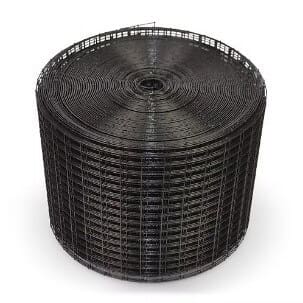
PVC-coated mesh, clipped around the outer edge of the panel array, sealing the gap between the panels and the roof.
Pros: Once it’s fitted properly, it’s effectively permanent (guaranteed by the manufacturer for 10 years). It physically prevents pigeons getting under the panels. It doesn’t shade them and doesn’t void manufacturer warranties when fitted with proper solar clips.
Cons: It’s not really a DIY job for most people, partly because of the height and partly because gaps of even an inch will be exploited.
Best for: Almost every domestic solar array with a pigeon problem. This is genuinely the method that works.
Bird spikes
Strips of plastic or stainless-steel spikes glued or screwed to the roof or panel edges to stop birds landing.
Pros: Cheap. Easy to fit. Effective at stopping pigeons perching on a ridge tile or chimney.
Cons: They don’t stop pigeons getting under the panels, which is the whole problem. Spikes work by making a landing spot uncomfortable, but pigeons can still hop and walk in from the side. On their own, they’re rarely the right answer for solar panels, though they can usefully complement mesh in some situations (for example, on a ridge tile right above an array where pigeons keep landing before dropping down).
Best for: Stopping perching, not stopping nesting. Useful as part of a wider plan, not as the main defence.
Netting
Larger-gauge mesh draped over a wider area, typically used on commercial buildings or warehouses to seal off whole sections of roof.
Pros: Effective for very large arrays or commercial installations. Cheaper per square metre than fitted mesh.
Cons: Looks worse on a residential property. Tends to sag and need re-tensioning over time. Not usually the right tool for a domestic roof.
Best for: Commercial-scale arrays where appearance matters less and the area is too large for fitted mesh to make sense.
Gel deterrents
Sticky or optical gels applied to surfaces. The idea is that pigeons either dislike standing in the gel or perceive it as fire (this varies by brand).
Pros: Easy to apply. Cheap.
Cons: Doesn’t work for solar panel proofing. It’s designed for ledges where pigeons land, not the gap underneath panels. Also tends to attract dust and debris, which reduces its effectiveness within months and looks unpleasant.
Best for: Specific perching spots elsewhere on a building, not solar panels.
Ultrasonic deterrents
Devices that emit high-frequency sound supposedly inaudible to humans but unpleasant to birds.
Pros: None we’re confident in.
Cons: The evidence that they actually work on pigeons is thin. Pigeons hear best at frequencies between roughly 1 and 2 kHz, well below the ultrasonic range these devices operate at, and several independent studies have found they have little to no measurable effect on pigeon behaviour.
Ultrasonic deterrents are popular online because they’re cheap and easy to ship, not because they’re effective.
Best for: Honestly, our view is don’t bother. Spend the money on one of the other methods.
Decoy hawks, owls and reflective deterrents
Plastic predators, mirror balls, holographic tape, scary-eye balloons.
Pros: Very cheap. Sometimes work for a few days.
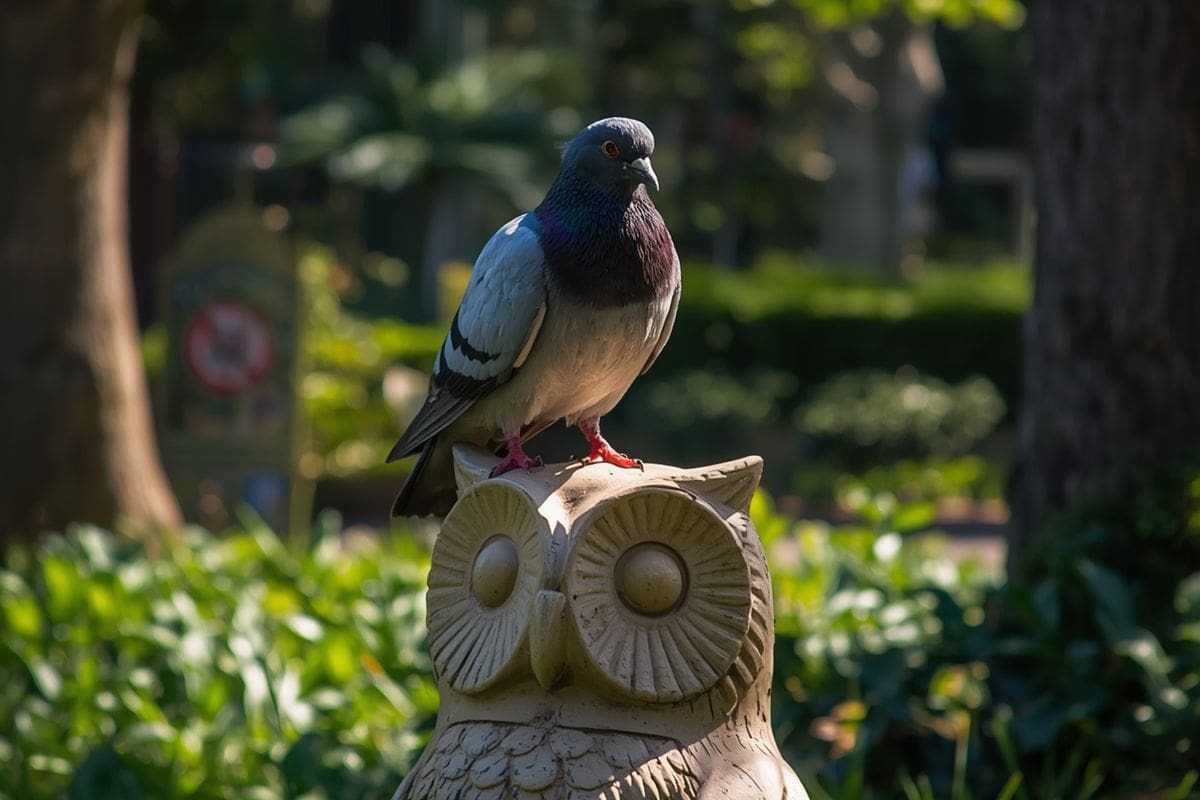
Cons: Pigeons habituate quickly. A plastic owl that doesn’t move becomes part of the scenery within a week. There’s a reason real falconry-based deterrence works (it’s a moving threat), but a static decoy doesn’t replicate that.
Best for: Short-term deterrence on a balcony or single perch, not a permanent solar panel solution.
Do lights attract pigeons?
This comes up a lot in searches and the answer is broadly no, lights don’t attract pigeons in the way they attract moths or some other insects. Pigeons are diurnal and roost at night, so external lighting on a building doesn’t pull them in. What can happen is that bright lights make a building feel more sheltered and predictable, but that’s marginal compared to the appeal of a warm, dry gap under a solar panel.
The lights to be more careful about are the ones inside your loft, which can sometimes encourage pigeons to investigate gaps if light is leaking out. But for outside lighting, no, you’re fine.
How do I pigeon proof my solar panels?
Assuming you’ve decided mesh is the right approach (and for almost all domestic solar arrays it is), the process is roughly:
- Get safe access. Ladders (we have years of experience and are fully trained in working at height), scaffolding for taller properties or long roofs.
- Clean the area properly. If pigeons have already been nesting, the area needs clearing of droppings, nesting material, eggs and any dead birds. This is hazardous waste because of the pathogens involved, so make sure you wear proper PPE and use biocide treatment.
- Fit the mesh. PVC-coated mesh is clipped to the outer edge of the panels using solar-specific clips. The mesh runs all the way down to the tiles, leaving no gaps.
- Check every edge. Pigeons exploit any gap larger than about an inch, so the work has to be thorough.
- Inspect annually. Mesh fitted properly should last over 10 years, but it’s worth a look once a year for damage or shifting.
Proactive mesh installation before pigeon’s settle is always recommended.
How much does it cost to pigeon proof solar panels
For a typical domestic solar array, expect to pay somewhere between £600 and £900 in total.
The variables are the size of the array, how easy the roof is to access, whether it can be carried out from ladders or if scaffolding is required.
Mesh material costs depend on quality. Cheap thin plastic mesh tends to go brittle within a few years, so it’s a false economy.
Scaffolding, if needed, typically adds £800 to £2000. This is why pigeon proofing is significantly cheaper if it’s done at the same time as the original solar panel installation, when scaffolding is already up.
If you’re getting quotes well below £300 for a retrofit, ask carefully what’s included. The labour and the access costs alone usually mean a proper job sits north of that.
Can I scare pigeons away permanently?
Not really. Pigeons quickly learn that the scary thing isn’t actually a threat, and they stop being bothered by it. The first time a plastic owl appears on the roof, they fly off. By day three, they’re sitting on it.
What you do is make the place they wanted to be unavailable. Once the gap under your panels is sealed, the warm sheltered nesting spot they were after no longer exists, and they move on to find somewhere else. That’s why mesh works permanently and why decoys, ultrasonic devices and reflective deterrents don’t.
If you want a single takeaway from this article, it’s that. The lasting solution isn’t deterrence, it’s exclusion.
When to call a professional
We often get asked – is this something I can do myself? And the honest answer is yes possibly you can. It is very dependant on your circumstances. But if you’ve got pigeons already nesting, if your panels are above ground floor level, or if you want the work to last at least ten years, it’s a job worth getting done professionally. Look for an installer who’s a member of the British Pest Control Association, which holds members to professional standards on training, insurance and humane practice.
We cover Oxfordshire, Berkshire and Buckinghamshire and we do a fair bit of solar panel pigeon proofing across the area. If you’re nearby and want a free quote, give us a ring on 01491 833282 and we’ll come and have a look.